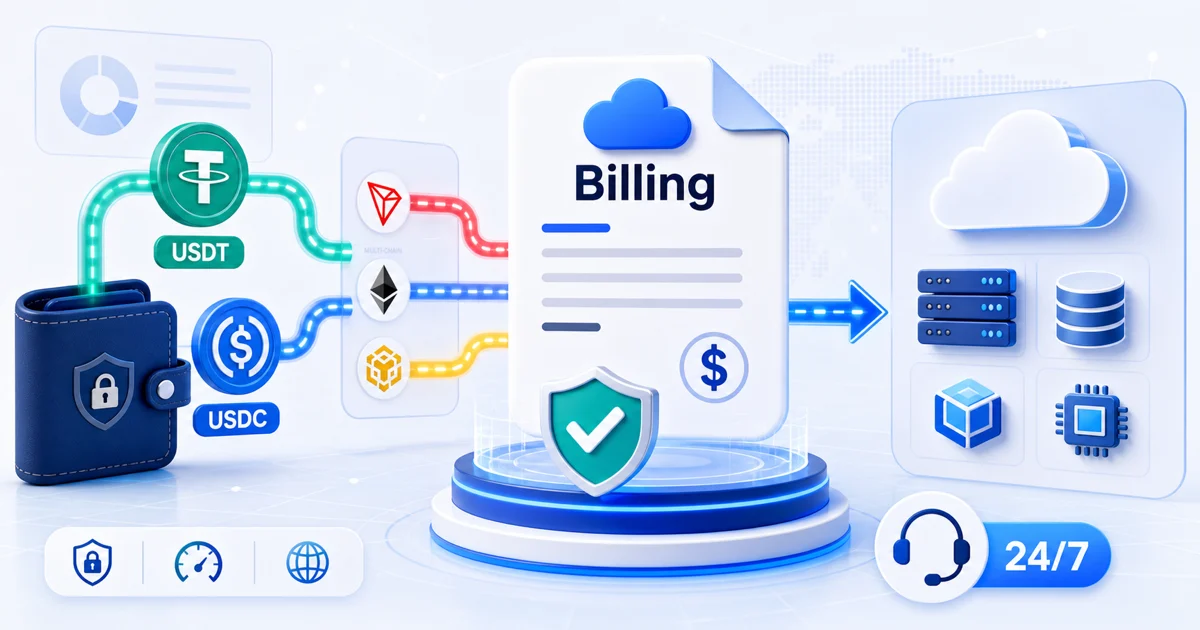
Paying an AWS bill with USDT or USDC through AWS51 means arranging third-party settlement. It does not mean that an AWS invoice is automatically paid when a wallet transfer completes, or that AWS endorses the intermediary. Confirm the billing arrangement, payment instruction and proof of settlement before sending funds.
This guide is intended for teams that already know their AWS account owner and need an auditable payment process. If ownership or recovery access is unclear, resolve that first using the provider due-diligence checklist.
Identify who owns the account and who pays
Write down the account ID, legal customer, recovery-email owner, current payer, invoice recipient and responsible finance contact. Distinguish settlement for an existing account from onboarding into a new account or organization. These are different arrangements with different exit requirements.
An AWS Organizations relationship can include centralized governance as well as billing. Before accepting an invitation, ask which organization features and policies will apply and how the member account can leave. Do not assume a reseller arrangement grants only billing access.
Request a quote against a defined invoice or usage scope
- Specify the billing period, currency, amount due, payment deadline and account IDs covered.
- Separate usage charges from taxes, support, Marketplace purchases, credits and contractual commitments.
- State whether funds pay a current invoice or form a deposit for future charges.
- Request the token/network pair, credited amount, exchange-rate basis, quote expiry and all fees.
- If a discount is offered, record its baseline, eligible products, duration and exclusions rather than relying on a headline percentage.
Do not infer that a deposit settles an overdue invoice or that a discount applies to every AWS charge. Obtain order-specific confirmation. The AWS51 AWS service page describes the scope that should be agreed.
Complete the transfer and verify settlement
- Check the instruction: verify the recipient, destination address, asset and network through your established contact channel. Reconfirm any last-minute change independently.
- Approve the amount: ensure the expected net receipt meets the quote after fees. If a small test is agreed, document how it counts towards the order.
- Keep the transfer record: record the transaction hash, timestamp, asset amount and order reference. Do not send wallet credentials.
- Obtain the service receipt: identify which AWS account and billing period the payment covers, including any remaining balance or adjustment.
- Verify the cloud record: compare the agreed settlement evidence against the relevant AWS billing records. Escalate discrepancies rather than treating a transfer confirmation as final proof.
Keep permissions separate from the payment method
USDT or USDC does not define an IAM boundary. Quote preparation should not require a root password, an MFA code or unrestricted administrator credentials. For any operational work, record the requested role, purpose, duration, approver and revocation procedure. AWS recommends least privilege, temporary credentials and protection of root credentials in its IAM security guidance.
If an organization relationship, delegated role or support integration is proposed, review it explicitly. A verbal description such as “billing-only” is not a substitute for examining effective access. See how to evaluate a reseller’s actual role.
Handle exceptions without compounding the problem
Agree the process for an expired quote, insufficient receipt, wrong network, rejected order or unused deposit before funding. Stablecoins can lose their peg, and transfer recovery is not guaranteed. A refund should have a documented valuation basis, recipient verification process and applicable fees.
If the account is restricted, preserve the notice, case number and billing evidence. Payment may address a billing issue, but it does not resolve every verification, security or policy issue. Neither payment assistance nor a technical-support channel guarantees reinstatement or a resolution time.
Before changing providers
Reconcile outstanding charges and deposits, export the records you are entitled to retain, confirm future payment responsibility, and plan access removal. Review the account’s organization status and business dependencies before making changes. Do not perform an unplanned billing transition on a production account to test whether an arrangement works.
For cross-cloud comparisons, use the multi-cloud settlement checklist. For an AWS51 quote, provide a redacted invoice and state your required payment and ownership constraints.
Reviewed by AWS51 Editorial Team on . Official documentation is linked where relevant. Examples are guidance, not evidence of a production test or a service guarantee.
Frequently Asked Questions
Does this mean AWS directly accepts USDT or USDC?
No. This guide describes third-party settlement through AWS51, subject to order-specific acceptance. It is not a statement about native cryptocurrency acceptance in the AWS billing console.
What AWS charges does a quote cover?
Only the account, billing period and charge categories identified in the quote. Confirm taxes, support, Marketplace items, commitments, prior balances and exclusions separately.
Is a reseller organization relationship always billing-only?
No. An AWS Organizations relationship can involve governance as well as billing. Review the actual features, policies, ownership and exit requirements before accepting it.
Can payment guarantee recovery of a restricted AWS account?
No. A restriction may involve identity, security or policy issues as well as payment. Preserve the provider notice and case reference and use the official remediation path.
