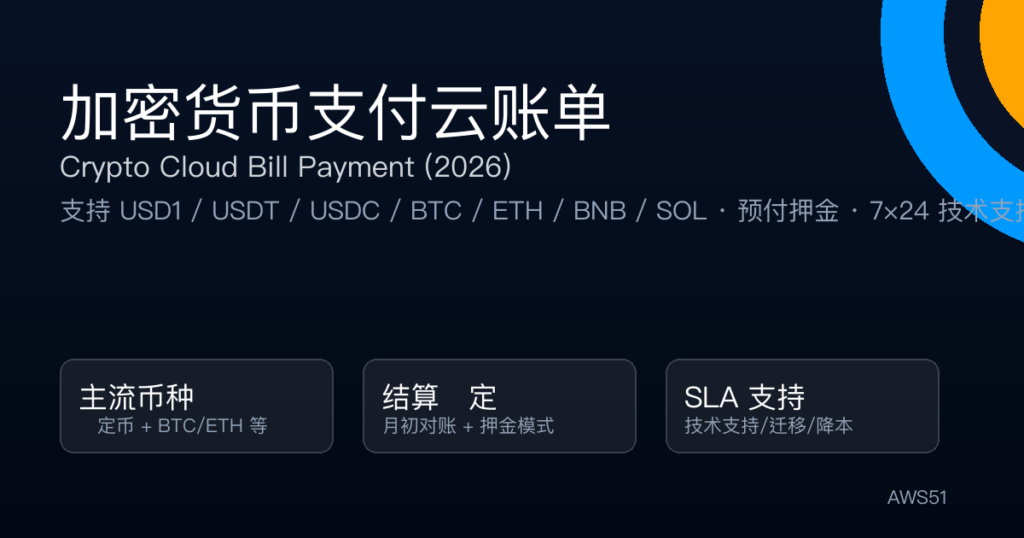
- Settle cloud bills with USD1/USDT/USDC (ERC20/TRC20/BEP20) and mainstream coins (BTC/ETH/BNB/SOL).
- Monthly cycle: statement at month start; deposit model helps prevent service disruption due to overdue bills.
- No extra service fee: settlement follows reseller pricing/discount rules (discount depends on usage and scope).
- Least privilege: billing-only access. No Root/Owner/admin access required.
- 24/7 response. Optional migration and FinOps cost optimization.
Last updated: Feb 14, 2026
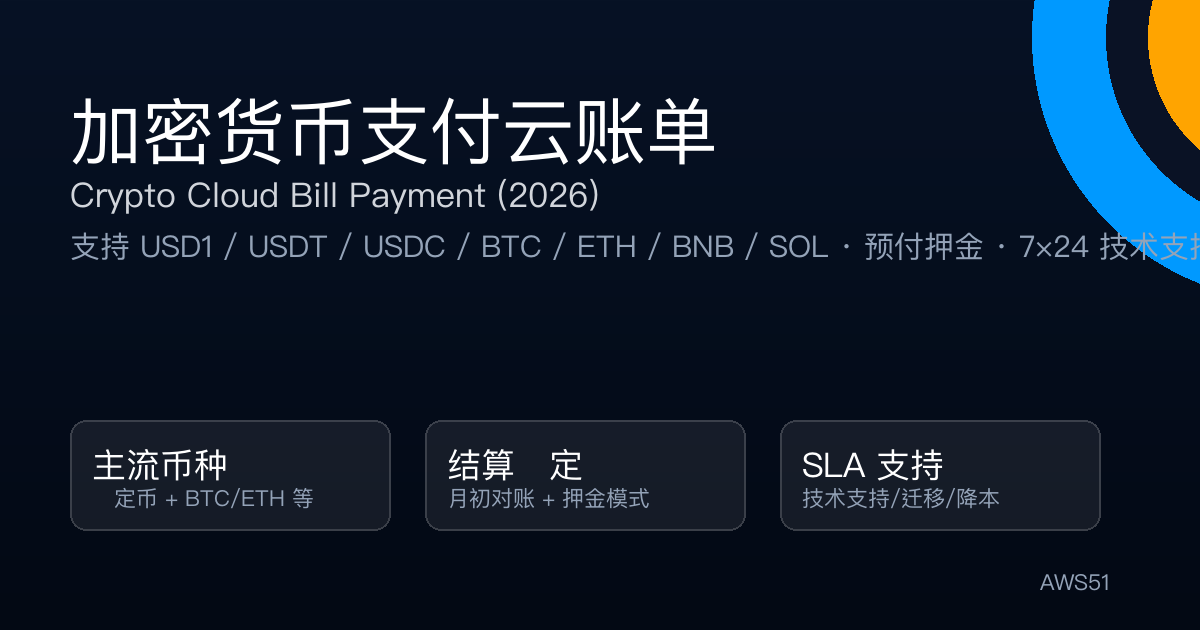
What is “Crypto Cloud Bill Payment”?
It is a settlement service where a provider helps you reconcile cloud usage and settle bills using stablecoins or mainstream coins, with clear permission boundaries.
Who is it for?
- Teams with cross-border settlement needs (multi-currency, multi-entity).
- Projects impacted by card limits, bank transfer friction, or payment interruptions.
- Businesses that need monthly reconciliation and cost governance (FinOps).
Supported clouds and coins
| Clouds | AWS, Google Cloud, Alibaba Cloud (International), Tencent Cloud (International), Huawei Cloud (International) |
| Coins | USD1 / USDT / USDC / BTC / ETH / BNB / SOL |
| Stablecoin networks | ERC20 / TRC20 / BEP20 |
| BTC | Exchange internal transfer (off-chain) |
| Model | Deposit / prepaid balance + monthly reconciliation |
| Support | 24/7 response; optional migration + FinOps |
Pricing & discounts
- No extra service fee. Settlement follows reseller pricing/discount rules.
- Discount depends on usage volume, cloud mix, and support scope.
Workflow (deposit model)
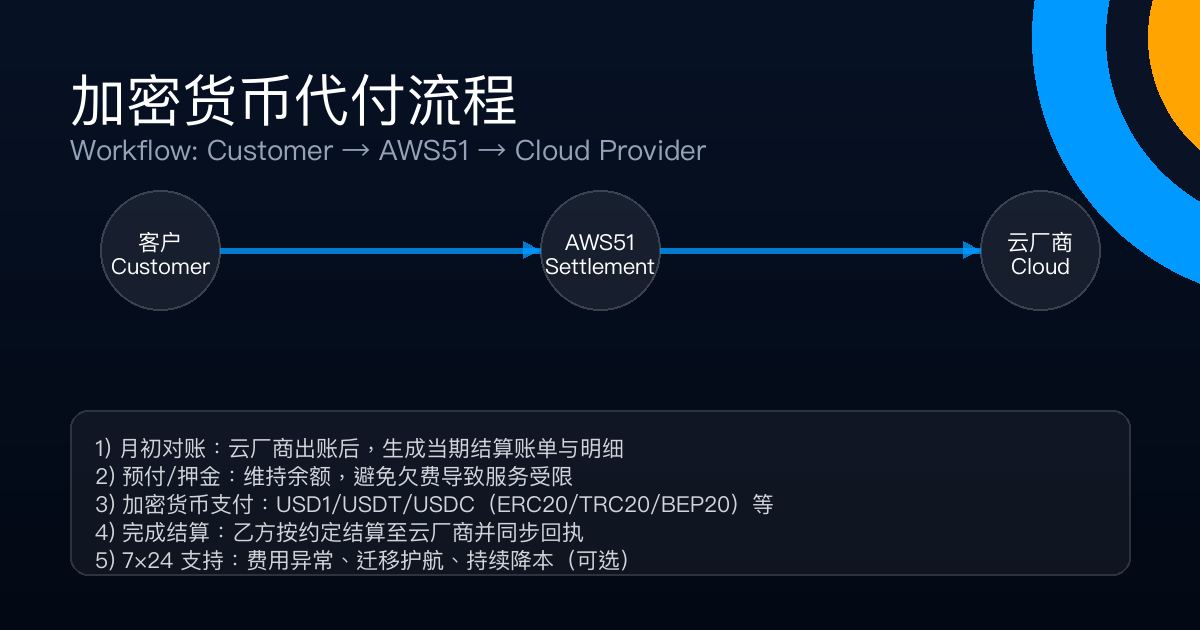
- Grant billing-only access (revocable).
- Maintain deposit balance based on estimated spend.
- At month start, review statement + breakdown and confirm coin/network.
- Pay with USD1/USDT/USDC or BTC/ETH/BNB/SOL per invoice.
- Settle and archive reconciliation artifacts.
Permissions boundary
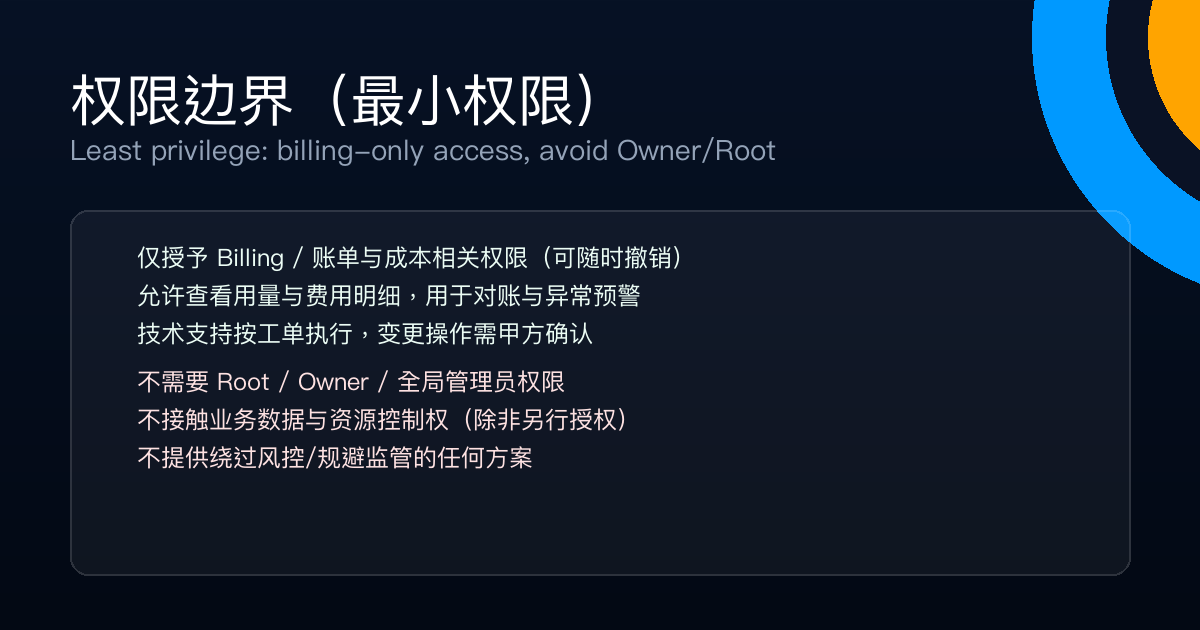
- Billing-only: view usage and billing data for reconciliation.
- No Root/Owner/admin access required.
- No “risk-control bypass” or policy evasion services.
Support & SLA
- 24/7 response for billing incidents and urgent coordination.
- Optional: migration planning/execution support.
- Optional: FinOps cost optimization (budgets/alerts, anomaly checks, monthly review).
Quick links by cloud
- AWS
- Google Cloud
- Alibaba Cloud (International)
- Tencent Cloud (International)
- Huawei Cloud (International)
FAQ
Q1. Can I pay the cloud provider directly with USDT/USDC?
In most cases, no. Cloud providers typically accept cards or bank transfers depending on region. For stablecoin/mainstream-coin settlement, a service provider usually handles settlement and reconciliation.
Q2. What coins and networks are supported?
USD1, USDT, USDC, BTC, ETH, BNB, SOL. Stablecoins: ERC20/TRC20/BEP20. BTC: exchange internal transfer (off-chain). Networks may vary per invoice.
Q3. What do you need to get started?
Billing account context, estimated usage, and required KYC/compliance materials.
Q4. What permissions do you need?
Billing-only least privilege, revocable at any time. Root/Owner/admin is not required.
Q5. What is the billing cycle and due date?
Monthly statement at the beginning of the month (often within days 1–7). Deposit model; top-up/confirmation within 10 days after statement.
Q6. How fast is settlement after payment?
It depends on coin/network confirmations and provider posting. Once funds are confirmed, settlement proceeds; urgent cases can be coordinated.
Q7. Can I stop anytime?
Yes. You can revoke billing access anytime. Please settle outstanding amounts for the current cycle before termination.
Q8. How do I prevent spikes/overdue bills?
Enable budgets and multi-threshold alerts, run monthly reconciliation, and remove idle resources. We can also provide anomaly alerts and optimization advice.
Official references
- AWS Billing
- Google Cloud Billing docs
- Alibaba Cloud Help Center
- Tencent Cloud Documentation
- Huawei Cloud Support
Get a quote / Start
Message us on Telegram. We’ll reply with a settlement plan (deposit model, coin/network, permissions) and a cost optimization checklist.
Frequently Asked Questions
Which cryptocurrencies are suitable for cloud bill payment?
Stablecoins such as USDT or USDC are usually easier for reconciliation than volatile assets, but the supported options depend on the provider workflow and risk policy.
What makes crypto cloud bill payment auditable?
Auditability comes from transaction hashes, provider receipts, credited cloud bills, account/project mapping and monthly reconciliation records.
Should teams pay production cloud bills with volatile tokens?
Use caution. Volatile tokens add exchange-rate risk and accounting complexity. Stable settlement assets and clear reconciliation are usually preferable.
