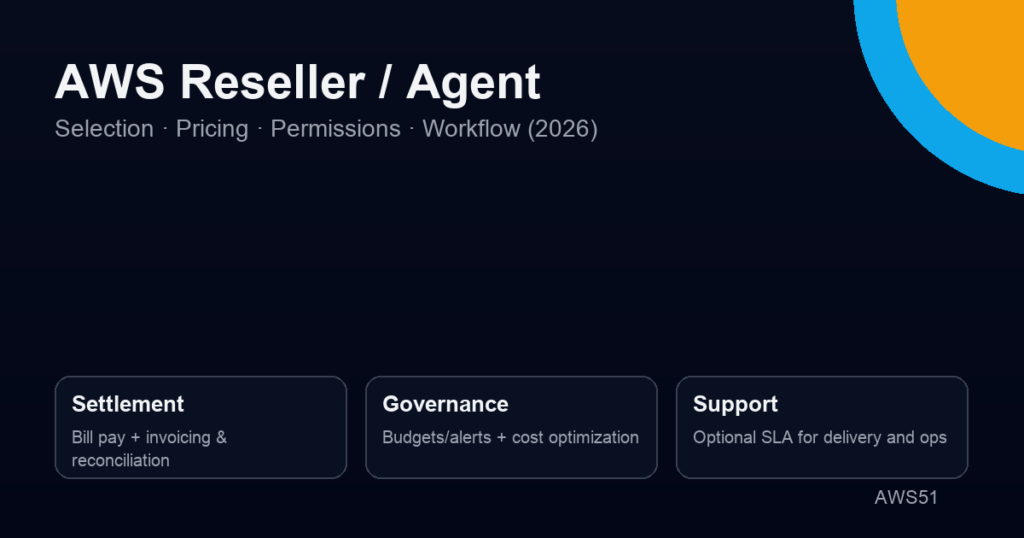
On AWS, the real friction is often not engineering — it’s payments, reconciliation, invoicing, and cost governance. Cards get declined, limits are too low, corporate settlement is hard, and cross-border payment flows are painful. That’s why many teams search for one thing: AWS reseller / agent.
TL;DR: An AWS reseller/agent typically helps with settlement, reconciliation, governance, and optional support — not with taking control of your resources. Prioritize transparency, least privilege, and a clear exit plan.
- Best for teams that need stable settlement and auditable reconciliation.
- Non-negotiable: never share root credentials; avoid Owner/Admin access.
- Red flags: “cheap” quotes without itemized reconciliation or permission boundaries.
Last updated: Feb 14, 2026
This post explains:
- What an AWS reseller/agent is and what they can do
- Self-serve vs reseller settlement vs enterprise agreements — which fits you
- How to choose a trustworthy AWS reseller (workflow + due diligence checklist)
3 non-negotiables:
- Reseller billing should not require account control transfer. Permission boundaries must be explicit.
- Discounts are not fixed. Pricing depends on region, usage tiers, and contract terms.
- Transparency + exit plan matter more than “cheap” quotes: itemized reconciliation, revocable access, and traceable payments.
At a glance: What is an AWS reseller/agent?
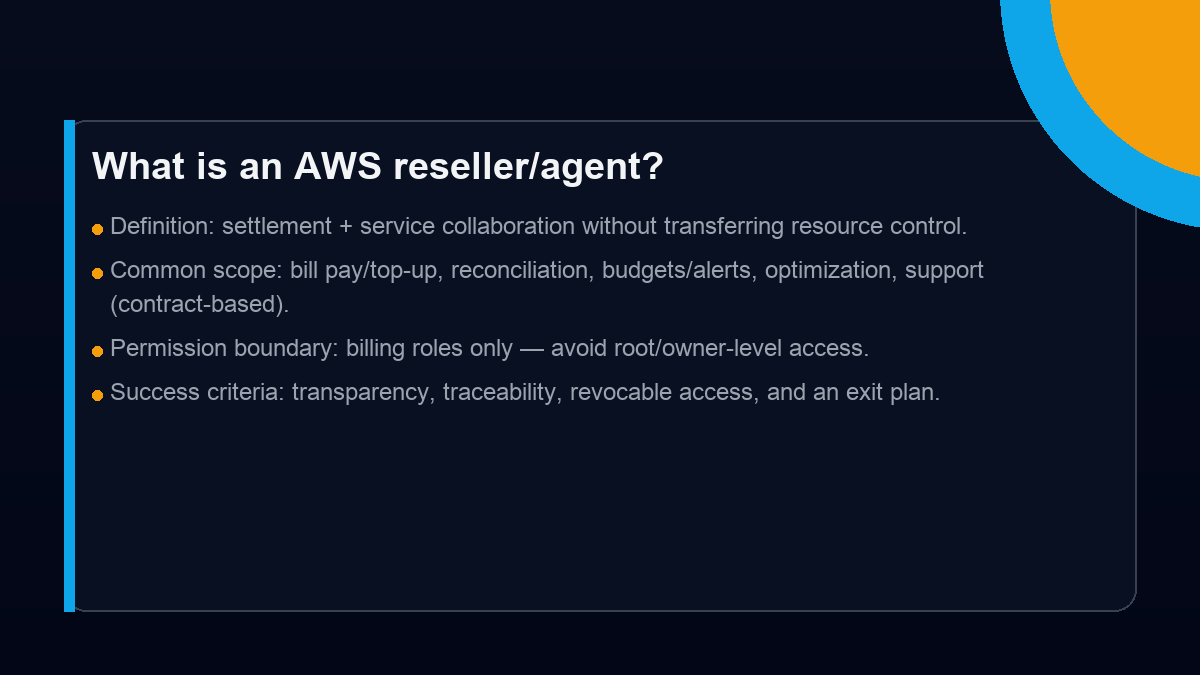
In practice, an “AWS reseller/agent” is a qualified provider that supports you on the settlement + service layer — e.g., bill pay/top-up, invoicing & reconciliation, budgets/alerts, cost optimization, and support. A healthy setup keeps you in full control of your AWS resources.
What problems can an AWS reseller solve?
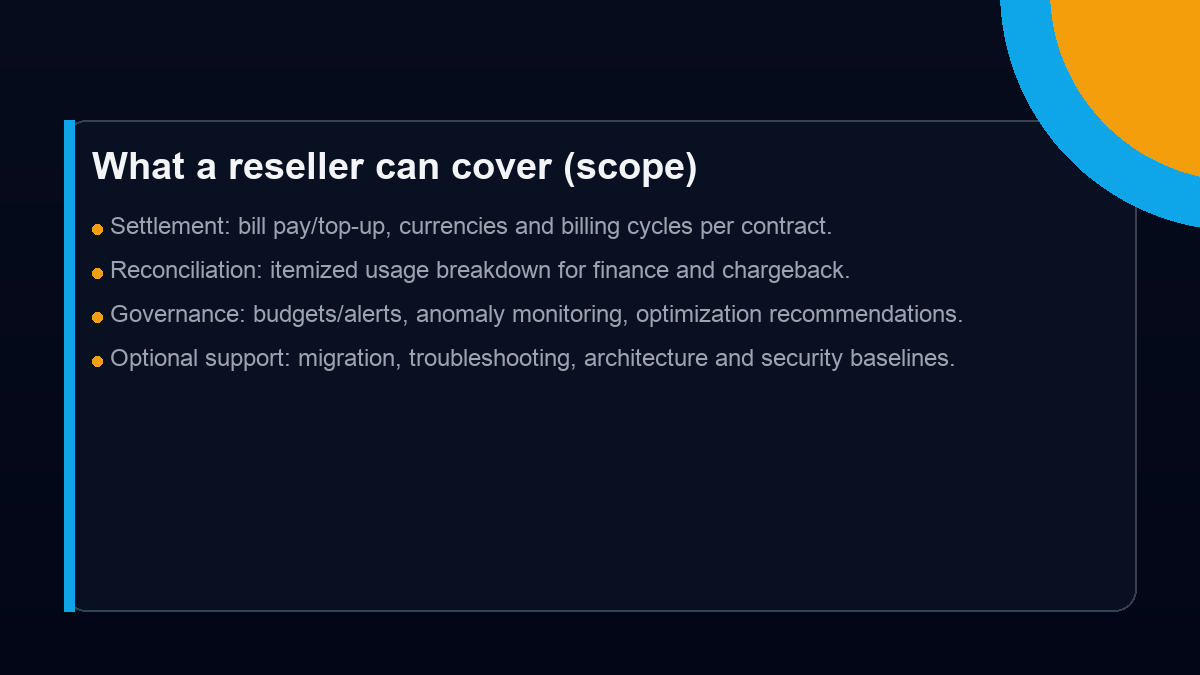
1) Payment and settlement stability
- Reduce payment failures caused by fraud controls, limits, 3DS, and address checks.
- Enable corporate-style settlement and invoice-ready reconciliation (contract-based).
- Support agreed currency and billing cycles to reduce operational friction.
2) Reconciliation and cost governance
- Provide itemized usage breakdown by project/label/service for internal chargeback.
- Budgets and alerts to prevent cost spikes (egress, logs, snapshots, idle resources).
- Ongoing optimization recommendations where applicable.
3) Optional support: troubleshooting and architecture optimization
Many teams choose a reseller not only for pricing, but for delivery stability and governance: clear permission boundaries, incident response, security baselines, and continuous cost control.
Self-serve vs reseller settlement vs enterprise agreements: how to choose
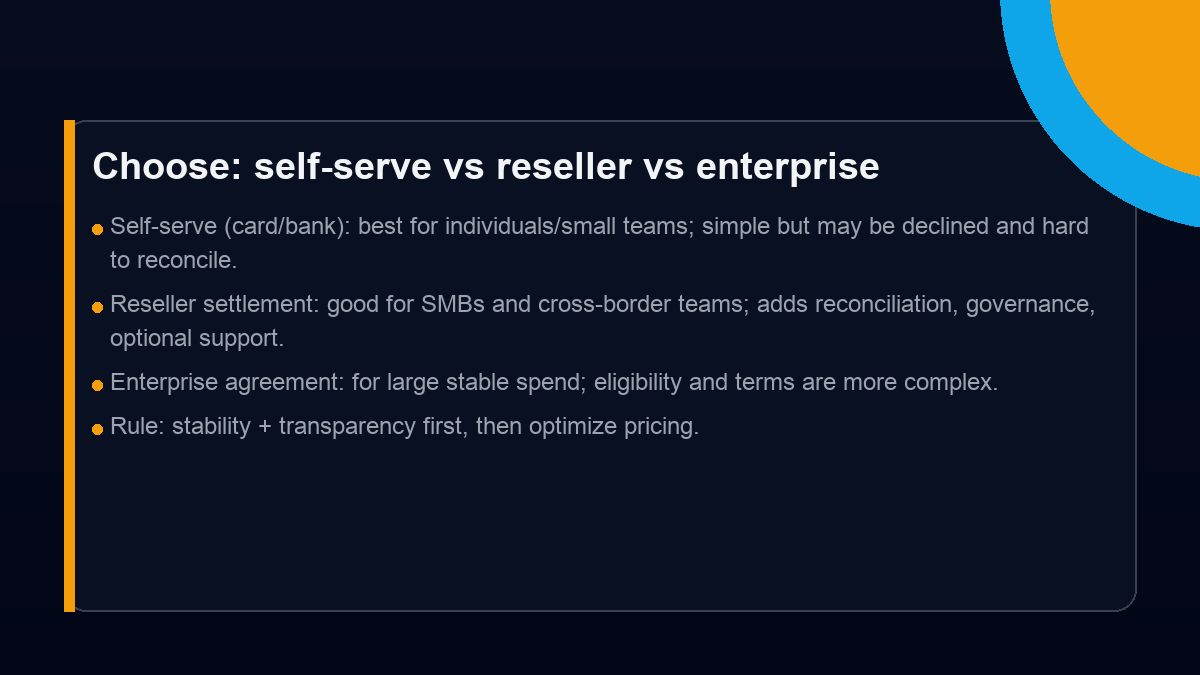
- Individuals / small teams: start with self-serve + budgets/alerts; consider alternatives if cards are declined.
- SMBs / cross-border teams: reseller settlement is often a practical fit for reconciliation and stability.
- Large enterprises: evaluate enterprise agreements if spend is stable (eligibility and terms vary).
Standard workflow with an AWS reseller
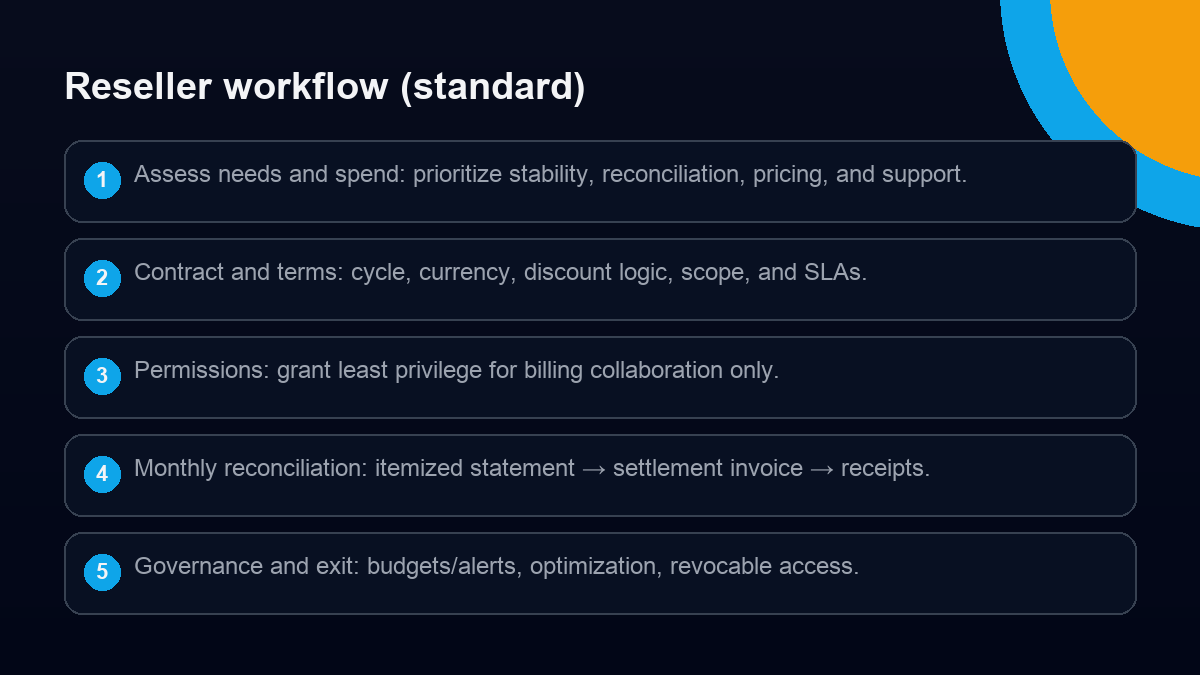
- Assess usage and requirements: share invoices or expected spend and define priorities.
- Quote & contract: confirm cycle, currency, discount logic, scope, and SLAs.
- Permissions: grant least privilege for billing-related collaboration only.
- Monthly reconciliation: receive itemized statements and settlement invoices per contract.
- Governance: budgets, alerts, optimization, and security baselines.
- Exit plan: revocable access and clear settlement closure.
Due diligence checklist: choosing a trustworthy AWS reseller
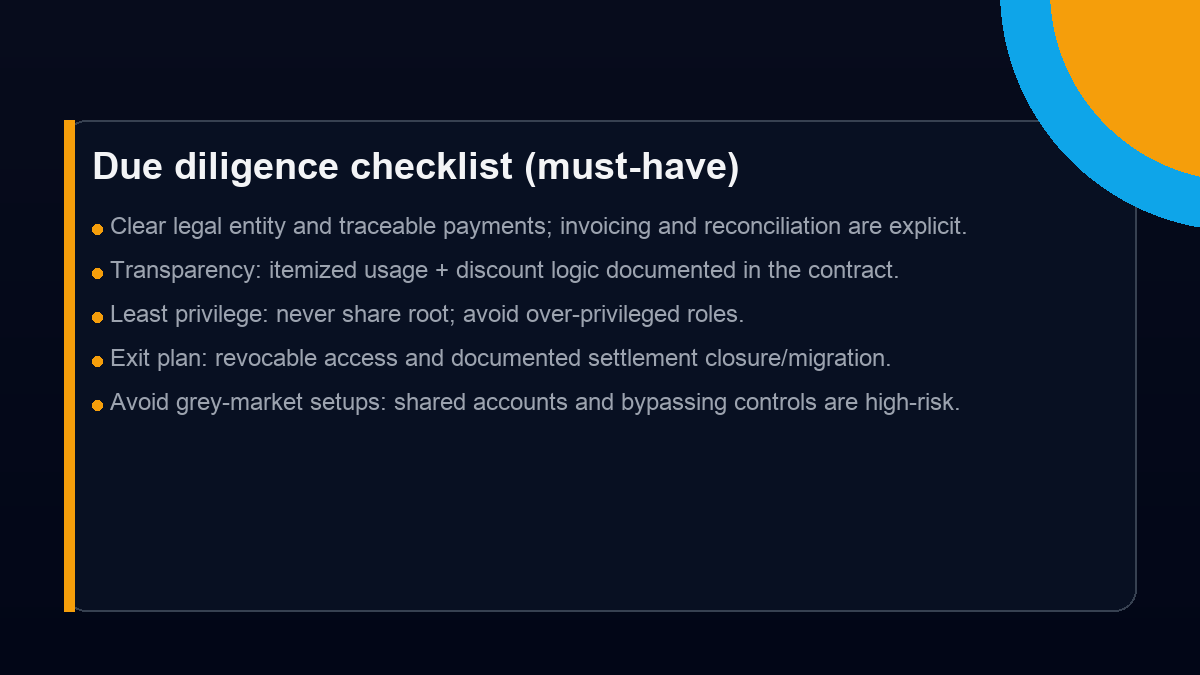
- Clear legal entity: consistent contracting and invoicing entity; avoid personal collection.
- Transparent billing: itemized usage and discount calculation written into the contract.
- Least privilege: never share root credentials; avoid over-privileged roles.
- Security & compliance: define data access, audit logging, and confidentiality terms.
- SLA and escalation: response time and support boundaries are explicit.
- Anomaly monitoring: cost spike alerts and governance recommendations.
- Exit mechanism: revocation and migration procedures are documented.
- No grey-market setups: avoid shared accounts or risk bypassing.
- Traceable payments: reconciliation invoices and receipts are auditable.
- Start small: pilot for one billing cycle before scaling.
FAQ
Q1: Do I need to share my AWS root credentials with a reseller?
No. Avoid sharing root credentials or passwords. Define a least-privilege approach and keep permissions scoped to the minimum required.
Q2: How do I verify reseller credibility?
Validate partner credentials via official partner directories where applicable, and ensure the contracting entity matches the billing/invoicing entity.
Q3: Will a reseller always be cheaper than self-serve?
Not necessarily. Stability, transparency, governance, and support are often more important than headline discounts.
Official references (AWS)
Need help? AWS51 AWS settlement & support
If you need AWS bill pay/top-up, reconciliation, budgets/alerts, and cost optimization support, see:
- AWS51|AWS Cloud Services
- Chinese page: AWS51|AWS 代理与账单代付服务
Disclaimer: This post is for informational purposes only and is not legal/financial advice. Payment methods, discounts, and settlement terms vary by contract and policy; follow applicable laws and compliance requirements.
