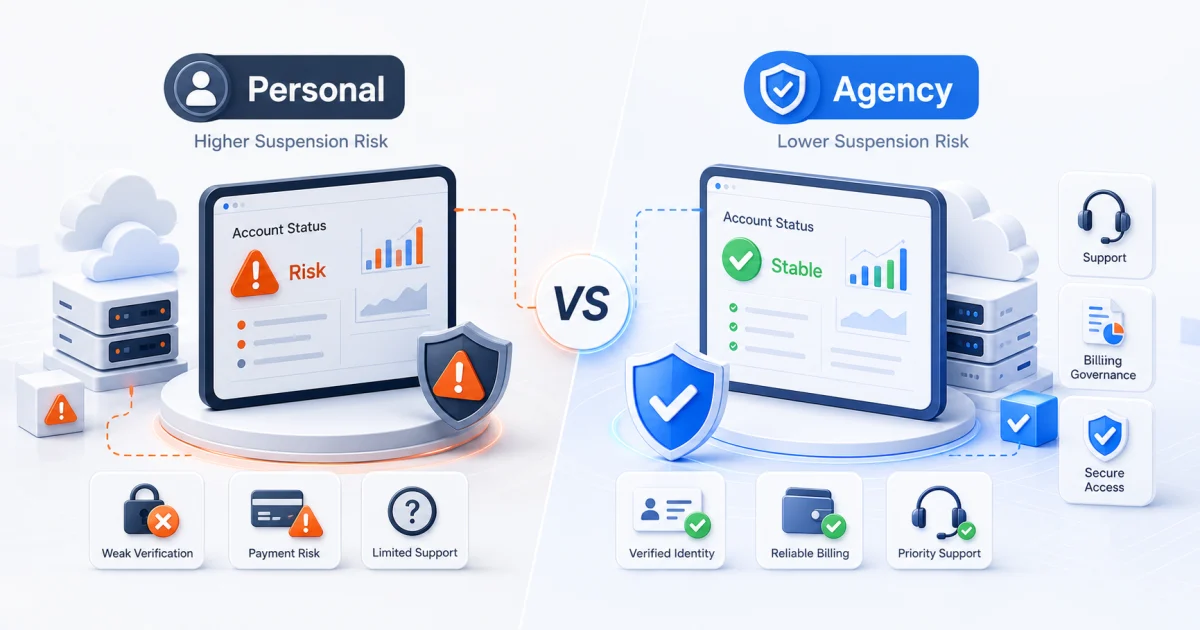
Short answer: if an AWS or Google Cloud account is already suspended, the first question is not “which account type is always safer?” but “what caused the restriction, who controls billing, and what evidence can be provided to the cloud provider?” Agency-managed billing and support can reduce some operational risks, but it does not override AWS, Google Cloud or local compliance policies.
For Southeast Asia teams running SaaS, gaming, AI, media buying, cross-border e-commerce or overseas infrastructure, account suspension is usually painful because it affects production access, invoices, customer traffic and emergency support at the same time. This guide compares personal cloud accounts and agency-managed accounts from a practical risk-control perspective.
TL;DR: agency vs personal cloud account risk
| Factor | Personal account | Agency or managed billing account | Practical note |
|---|---|---|---|
| Billing continuity | Depends on one card, one payer and one account owner. | Can use managed payment, monthly settlement or prepaid balance. | Useful when cards fail, FX settlement is unstable, or invoices need monthly reconciliation. |
| Verification | Owner must handle identity, business and payment verification directly. | Agency can help organize billing documents and support workflow. | The cloud provider still makes the final decision. |
| Support path | Usually handled through the account owner’s support plan. | May include operational support and escalation coordination. | A support path is not a guarantee of reinstatement. |
| Governance | Often simple at the start, but weak when multiple teams share one account. | Can separate billing, project, IAM and cost reporting responsibilities. | Better for teams that need auditability and monthly cost control. |
| Exit risk | Account ownership is clear if the user created and controls the account. | Must be defined in writing before migration or payment starts. | Confirm account ownership, data export, billing transfer and shutdown process. |
Why AWS and GCP accounts get suspended or restricted
Cloud account restrictions are usually triggered by a combination of billing, verification, security and policy signals. Common examples include failed card payments, unpaid invoices, suspicious sign-in behavior, sudden resource spikes, crypto-mining patterns, abuse complaints, identity review, unusually high GPU or compute usage, or mismatch between billing information and actual usage.
In many cases, the restriction is not permanent at first. The provider may ask for payment confirmation, identity information, business explanation, resource usage details or a security remediation plan. The quality of the response matters: vague statements like “please reopen the account” are weaker than a structured reply with invoice records, project purpose, affected services, security steps and a clear commitment to policy-compliant usage.
What an agency-managed account actually changes
An agency or managed billing model mainly changes the operating layer around the cloud account. It can help with payment reliability, cost visibility, invoice collection, cloud bill reconciliation, resource handover planning and support coordination. For teams that lack international cards, have unstable payment channels, or need monthly settlement in USD, USDT or local finance workflows, this can remove a real operational bottleneck.
However, an agency relationship does not create an official exemption from AWS or Google Cloud rules. It does not make prohibited workloads acceptable, does not bypass identity verification, and does not guarantee that a suspended account will be restored. Any provider claiming guaranteed reinstatement, unlimited policy bypass or “whitelisted accounts” should be treated as high risk.
When a personal cloud account still makes sense
A personal account can be appropriate for early testing, small proof-of-concept projects, individual learning, low-budget workloads, or teams that can use their own company card and maintain direct ownership of all assets. The main advantage is control: the account holder owns the login, billing method, projects, IAM permissions and provider relationship from day one.
The weakness appears when the project grows. If the same personal account starts carrying production traffic, multiple developers, larger monthly spend, GPU usage, advertising systems, customer data or cross-border services, weak governance becomes expensive. A failed payment, owner absence, lost MFA device or sudden verification request can stop the entire operation.
When an agency or managed billing model is a better fit
An agency-managed model is more suitable when cloud usage is already business-critical and payment reliability matters. Typical scenarios include teams in Southeast Asia paying AWS or GCP bills without a stable international card, companies needing monthly reconciliation, startups using multiple cloud providers, AI teams with fast-changing GPU spend, and operations teams that want support for migration, monitoring, billing alerts and cost optimization.
The real benefit is not that the account is magically “safe.” The benefit is that billing, support and operating procedures are more structured. A good provider should help define access boundaries, keep payment records, separate billing permissions from resource control, provide monthly statements, and document what happens if the customer wants to leave or move workloads later.
What to check before using an agency account
- Account ownership: confirm who owns the root account, organization, projects and billing account.
- Permission boundary: avoid giving unnecessary root, owner or full administrator access when billing-only access is enough.
- Payment evidence: keep invoices, payment receipts, USDT transaction hashes if applicable, and monthly settlement statements.
- Workload policy: confirm that the workload complies with cloud provider terms, especially for high-risk compute, scraping, bulk messaging, proxies or unusual traffic patterns.
- Exit plan: define how resources, domains, backups, images, billing exports and project ownership can be transferred if cooperation ends.
- Support scope: distinguish billing support, migration support, technical support and compliance remediation. They are different services.
What to do if your AWS or GCP account is suspended
- Read the provider notice carefully. Identify whether the issue is payment, identity verification, policy, abuse, security or unusual usage.
- Freeze risky changes. Do not repeatedly create new accounts, change cards, rotate identities or launch similar workloads before understanding the root cause.
- Collect evidence. Prepare invoices, payment records, domain ownership, business website, project description, security remediation notes and affected resource list.
- Submit a concise appeal. Explain what happened, what was fixed, and how future compliance will be maintained.
- Prepare continuity options. If restoration is delayed, evaluate backup restore, multi-account migration, DNS failover or a new compliant environment.
How AWS51 can help, and what we do not promise
AWS51 focuses on cloud billing payment, managed account support, cost coordination and practical operations assistance for AWS, Google Cloud, Alibaba Cloud International and Tencent Cloud International users. For teams with payment bottlenecks or weak billing governance, we can help evaluate managed billing, prepaid settlement, USDT/USDC payment, monthly reconciliation and migration planning.
We do not promise policy bypass, guaranteed reinstatement, anonymous abuse infrastructure, or support for workloads that violate cloud provider terms. A sustainable cloud account setup should be built around clear ownership, compliant usage, payment records, least-privilege access and an exit plan that protects the customer’s business.
Decision framework
Choose a personal account when the project is small, experimental, directly owned by one team, and payment is stable. Consider an agency or managed billing model when the project is production-facing, monthly spend is significant, payment channels are unstable, or the team needs help with billing governance and cloud operations. If the account is already suspended, focus first on root-cause evidence and provider communication before changing account structure.
相关服务与实用指南
常见问题
Is an agency AWS or GCP account officially safer than a personal account?
Not automatically. An agency or managed billing model can improve payment reliability, billing governance and support workflow, but AWS and Google Cloud still enforce their own verification, abuse and compliance policies.
Can an agency guarantee that a suspended AWS or GCP account will be restored?
No reliable provider should guarantee reinstatement. Restoration depends on the suspension reason, provider review, payment status, identity verification, workload policy and the quality of evidence submitted.
What should I check first after a cloud account suspension?
Start with the provider notice and determine whether the issue is billing failure, identity review, abuse report, security incident, unusual usage or policy violation. Then collect invoices, payment records, project purpose and remediation steps.
When is a personal cloud account still acceptable?
A personal account is reasonable for learning, prototypes, small workloads and projects where the owner controls payment, MFA, IAM and billing directly. For production workloads, stronger governance is usually needed.
What is the biggest risk when using an agency-managed cloud account?
The biggest risk is unclear ownership. Before using any managed account, confirm account control, billing export, permission boundary, payment evidence, data handover and exit process in writing.
Does AWS51 support USDT or USDC payment for cloud bills?
AWS51 can support cloud bill payment workflows that include USDT or USDC settlement for eligible customers and scenarios. The exact arrangement depends on platform, account status, payment amount and compliance requirements.
